

🔵 How a 1971 letter anticipated the music business of 2026
Revisiting Bill Graham’s Plea for "New Blood" in an era of The Constant Now
My buddy Adam Callan at Second Nature sent me this fantastic letter written by Bill Graham back in 1971. He felt, quite correctly, that it was eerily relevant to where we find ourselves in 2026.
I would go a step further and say that Graham’s words ring true on two separate levels.
First, you could receive it as a comment on the state of the grassroots music industry, which in the UK has received yet another damning report from the UK’s Music Venue Trust. That report was very well covered by Drowned in Sound, so rather than repeat the findings etc I would I recommend reading that excellent piece here.
Second, I feel it could be taken as a comment on the state of emerging music in 2026 too.
This is the letter, but I have transcribed it below for readability:
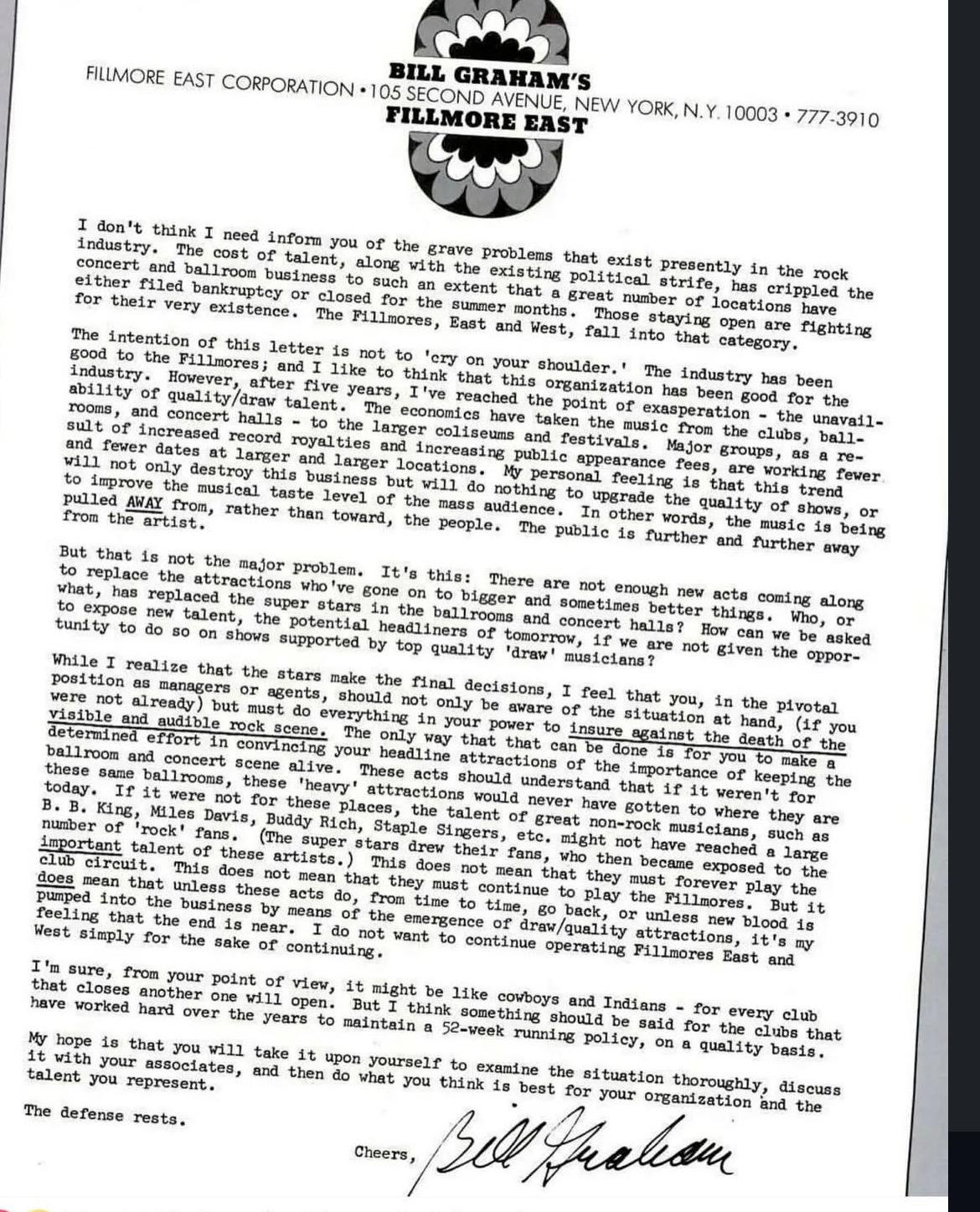
BILL GRAHAM’S FILLMORE EAST FILLMORE EAST CORPORATION • 105 SECOND AVENUE, NEW YORK, N.Y. 10003 • 777-3910
I don’t think I need inform you of the grave problems that exist presently in the rock industry. The cost of talent, along with the existing political strife, has crippled the concert and ballroom business to such an extent that a great number of locations have either filed bankruptcy or closed for the summer months. Those staying open are fighting for their very existence. The Fillmores, East and West, fall into that category.
The intention of this letter is not to ‘cry on your shoulder.’ The industry has been good to the Fillmores; and I like to think that this organization has been good for the industry. However, after five years, I’ve reached the point of exasperation - the unavailability of quality/draw talent. The economics have taken the music from the clubs, ballrooms, and concert halls - to the larger coliseums and festivals. Major groups, as a result of increased record royalties and increasing public appearance fees, are working fewer and fewer dates at larger and larger locations. My personal feeling is that this trend will not only destroy this business but will do nothing to upgrade the quality of shows, or to improve the musical taste level of the mass audience. In other words, the music is being pulled AWAY from, rather than toward, the people. The public is further and further away from the artist.
But that is not the major problem. It’s this: There are not enough new acts coming along to replace the attractions who’ve gone on to bigger and sometimes better things. Who, or what, has replaced the super stars in the ballrooms and concert halls? How can we be asked to expose new talent, the potential headliners of tomorrow, if we are not given the opportunity to do so on shows supported by top quality ‘draw’ musicians?
While I realize that the stars make the final decisions, I feel that you, in the pivotal position as managers or agents, should not only be aware of the situation at hand, (if you were not already) but must do everything in your power to insure against the death of the visible and audible rock scene. The only way that that can be done is for you to make a determined effort in convincing your headline attractions of the importance of keeping the ballroom and concert scene alive. These acts should understand that if it weren’t for these same ballrooms, these ‘heavy’ attractions would never have gotten to where they are today. If it were not for these places, the talent of great non-rock musicians, such as B. B. King, Miles Davis, Buddy Rich, Staple Singers, etc. might not have reached a large number of ‘rock’ fans. (The super stars drew their fans, who then became exposed to the important talent of these artists.) This does not mean that they must forever play the club circuit. This does not mean that they must continue to play the Fillmores. But it does mean that unless these acts do, from time to time, go back, or unless new blood is pumped into the business by means of the emergence of draw/quality attractions, it’s my feeling that the end is near. I do not want to continue operating Fillmores East and West simply for the sake of continuing.
I’m sure, from your point of view, it might be like cowboys and Indians - for every club that closes another one will open. But I think something should be said for the clubs that have worked hard over the years to maintain a 52-week running policy, on a quality basis.
My hope is that you will take it upon yourself to examine the situation thoroughly, discuss it with your associates, and then do what you think is best for your organization and the talent you represent.
The defense rests.
Cheers,
[Signature: Bill Graham]
Is history repeating itself? I have long held a view that history is certainly cyclical, so yes, I feel it is on one level or another.
Whether we feel that is currently a positive or negative thing is perhaps for you, the reader, to decide.
Have a great day - and thanks again Adam for sharing the letter.
D.
🎶 Listening to “w/The Producers” by Paul St Hilaire. Long time readers know of my love for all things Basic Channel, and by extension Rhythm & Sound, so I am surprised that it has taken me this long to check out this album, in which St Hilaire partners with an array of producers for another slice of Berliner dub. Current favourite track is the one with Mala, whose throbbing sub bass is as masterfully controlled as ever. The whole record is amazing though - make time for it.
📺 Watching “OMA - burnt. EP (Live Session) | Instrumental HipHop Beats” on YouTube. How OMA are bigger than they are is a mystery to me; the talent is undeniable. I love this clip though, which plants the band on what looks like a mossy hillside behind a disused factory, from which they deliver a dazzling array of phenomenal, sampleable instrumental hip-hop. That drum sound… 🤌🏻🤌🏻🤌🏻
🗣️ Playing with Monologue. Dictation tools are something I’ve always been interested in, but which have always come up short. Monologue, on the other hand, has perfectly hit the spot to such an extent that I’ve used it to dictate both this Network Notes and the last one. I think what separates it from the pack is that it uses a layer of AI to filter out the extraneous ‘ums’ and ‘errs’ that one can include when dictating, but which also recognises tone depending on which app you’re in. It’s incredibly smart and for me has been a massive productivity booster. Check it out.
Very interesting.
Thanks for the letter and the transcription.
It's sad that in order to find new artists (and for new artists to discovered) they have to be pushed by an algorithm. Artists have to appeal to the algorithm and not the people in the system we have accepted.