

🔵 The ever-growing management/label push-pull
That awkward sense of who owns what, and who effects change
On Jan 23rd, I attended Music Ally’s excellent Connect event here in London. My contribution was on a panel focused on Supremium, that is, the superfan tier that everybody is so keen to extract value from in 2026.
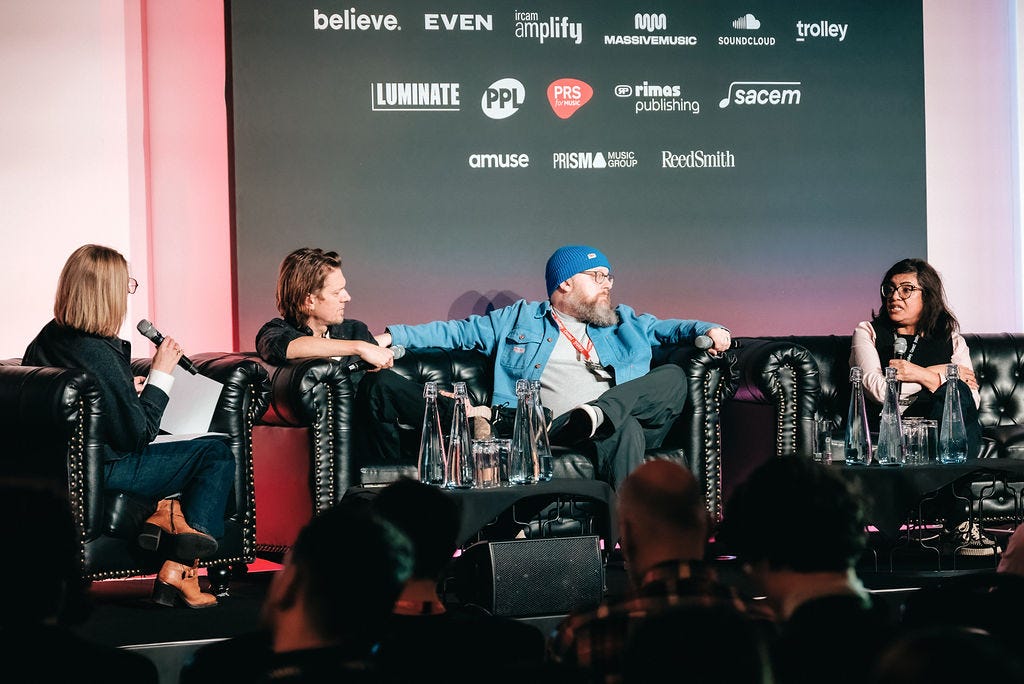
Prior to my own panel starting though, I was able to watch a fantastic conversation with Niamh Byrne of Eleven Management. In it, Niamh spoke at some length about the shift to a more management-centric world for Gorillaz, whose new album, she mentioned, would be released fully independently. What really caught my attention was when Niamh was asked whether bands need labels anymore. Her answer was a fairly simple “no”, though she did remark that funding is the number one challenge for artists and that labels certainly have a role to play in that regard.
All of this stood in contrast to the tone taken by my fellow panellist James Healy, SVP of Digital Business and Strategy at Universal Music. He was keen to talk up Universal’s role to play in generating more revenue for artists via deals with anyone from Spotify (with the 1,000 plays move) or Udio (with the new AI music platform). From a purely business perspective, when you consider this position in the context of representing hundreds of thousands of recorded works, he has a point.
Ultimately though, what became clear to me was that we have two arguably key stakeholders for most artists - managers and labels - moving in opposing directions.
What is being laid bare is the proximity to the art itself versus the exploitation of the product of that art - and therefore the revenue generated through it.
Managers are solely interested in their own artists and what those artists are seeking to achieve. It is their role to support how they may be empowered to do so, such that they are not only able to express themselves through their art, but to make a living - and ideally a very good one too.
Businesses like Universal, on the other hand, are large-scale operators. Their role is to increase revenue across everything they have an interest in. Hence a focus on DSPs and matters like increasing the threshold at which artists get paid, as they did with both Deezer and Spotify.
Perhaps the flashpoint emphasising the opposing pulling forces is AI, unsurprisingly. As we have been seeing, Universal are very much talking up the possibilities of its partnership with Udio, and at both the panel I was on and a previous day’s panel, mention was made of how great it would be to hear what it would sound like had Jimi Hendrix recorded Miles Davis’s Bitches Brew, for example.
This exploitation, or some might even say desecration, of the artist’s work via the medium of AI is where I would imagine managers are getting agitated. Put simply, they quite probably feel that it is not for a record label to allow this kind of exploitation to occur.
It is worth stressing that Universal have repeatedly stated that if an artist is not prepared to give permission for AI exploitation, they would not seek to enforce it. However, I feel just the space itself exposes the tensions between managers and labels. When you see notable managers such as Niamh Byrne suggesting that labels are no longer required, that should give serious cause for concern as to how the future may look if you are someone like Universal Music. Yes, there is a vast mine of catalogue for a company like that to exploit, but if that catalogue does not evolve with new music, it will ultimately diminish in value and expire, particularly if new and emerging artists are all working independently and eating into that attention bandwidth.
A power shift is very much at play here. I have written in the past that the likes of Universal’s major label model is already in tatters, which is why it is so desperately chasing down acquisitions of independent music companies. As long as managers hold the power though, I can only see them doing tougher and tougher deals with shorter licence terms that ultimately mean this path that Universal is following will soon be cut short.
Maybe the most telling thing here is the degree to which Universal truly feels it is innovating on behalf of artists and just how much of a role it has to play. Is it that essential though? I am increasingly thinking not.
Let’s see.
Have a great day,
D.
🎶 Listening to: everything on the Echocord label. Whenever I get time, I do enjoy going down a Discogs wormhole where I start with an artist I love, then look at which label they’re on, then nose through the other artists and releases on that label. Echocord is one such example, and so far absolutely everything on it is blowing my mind. Mind you, what chance did I have when the label is all about the celebration of dub culture as shot through modern techno?! Fantastic stuff.
📺 Watching Kate Bush’s 1979 BBC Christmas Special. Friday night was a bad night to be a bottle of sake in my house. However, as I sat in a sake-infused haze around 11pm, I whacked this on and it kind of blew my mind to watch it again. My good friend Dev made a fine point, too: at the time this aired, there were only three TV channels in the UK. So the notion that the BBC handed over the best part of an hour to Kate Bush and her modern interpretive dance while delivering songs that range from utterly classic to quite bizarre is truly a thing of wonder. (Also, as an aside, the fact that Kate Bush was only 15 when she wrote The Man With The Child In His Eyes continues to blow my mind to this day. Just incredible.)
🎧 Playing with Outgrowth, a new sampler plugin that Motive Unknown may soon be working with. So far, it’s blowing me away; combine the means to granularise sample points with modulation and you have some incredible means to produce textures for the kind of music I like making. I generally have avoided using samples when making music, but plugins like this (and Bitwig’s own stock sampler, which I adore!) are most definitely bringing me back around to the power within them.
🤖 Playing with my new Samsung Galaxy Buds Pro 3 (good GOD what a mouthful that name is!). It is crazy to see just how far noise cancellation has come, and now when you add in things like AI running to detect whether a noise is something you should pay attention to, I can’t lie, I’m impressed. Crucially though, the sound on these things is absolutely ridiculous. The bass response is like nothing I’ve heard for an in-ear headphone, and I absolutely love it.
Fancy coming to FFWD?
I mentioned recently that I would be speaking at the FFWD conference that is taking place next Tuesday. Final tickets are selling out quick, but if you fancy coming along, click this link, grab your ticket, and I shall see you there, as will other members of the Motive Unknown team. Looking forward to this one!
Been seeing this unfold via all the guest speakers I get to talk too, to the point where the big pop management companies are negotiating different types of deals to reflect their handing of the artist development.
Does seem that management are doing the boots on the ground development work, and have been for a while, in part due to staff and budget cuts at labels, but also because the major music companies want to focus on catalog, and pick things up when they meet some kind of catalog value level
This piece really made me think. Your point about the "two arguably key stakeholders...moving in opposing directions" is spot on. This divergence creates significant friction, a complex system artists must navigate. The funding challenge Niamh mentioned is a cental node in this network.