

🔵 We have a "music industry commentary" problem
Amplifying bad wisdom is not helping anyone, sorry...
It has not escaped my notice that in recent months we’ve had quite the rash of music industry commentator newsletters popping up, particularly here on Substack, where Network Notes lives.
I will confess that I harbour a good deal of cynicism towards industry commentators who have no skin in the game. By that, I mean that they have no actual professional experience working within the music industry and only exist in a bystander or observer capacity. I am even more cynical of commentators who upsell products aiming to help people make it in music.
Generally, I choose to ignore these publications because ultimately they are all opinions and everyone’s welcome to them, even if I don’t agree with what’s being said. What has bothered me of late, however, is a pervading sense that bad wisdom is being perpetuated, or that even worse, people are using the worst types of theories and headlines to bait people into reading or subscribing, presumably in a bid to drive up their own revenue.
The first evidence of this was the now grossly over-discussed Chaotic Good episode. My number one problem with this whole event was that it seemed to give a green light to anyone that wanted to write off all marketing as being some kind of “psyop”. Ever since, there’s been a pervading notion that everything you’re seeing is fake and whatever band you are finding yourself enjoying is a consequence of being mentally hoodwinked by some unbelievably clever agency.
Real talk: absolutely nothing about the Geese episode holds up to any scrutiny, for the simple reason that almost nobody chose to do any fact checking about what went on. Had they done so, it would have been very clear that Chaotic Good only got involved long after Geese had established their reputation. Furthermore, the only people that did look into the numbers - the very excellent Garbage Day newsletter - concluded that whatever accounts Chaotic Good were running to “hack the algo” were embarrassingly bad. The idea therefore that everyone was duped into liking this band through nefarious means is, on multiple levels, absurd.
Equally, it has to be stated very clearly that I genuinely don’t feel that people are so weak-willed and stupid that they are able to be hoodwinked into liking anything anyway. That narrative isn’t sexy or saleable though, so it makes for much easier reading to repeat the notion that everything you’re seeing everywhere is a psyop and it’s all fake.
Sadly these kinds of themes eventually get picked up and amplified by people with a considerable audience with which to spread bad wisdom.
Enter James Blake:
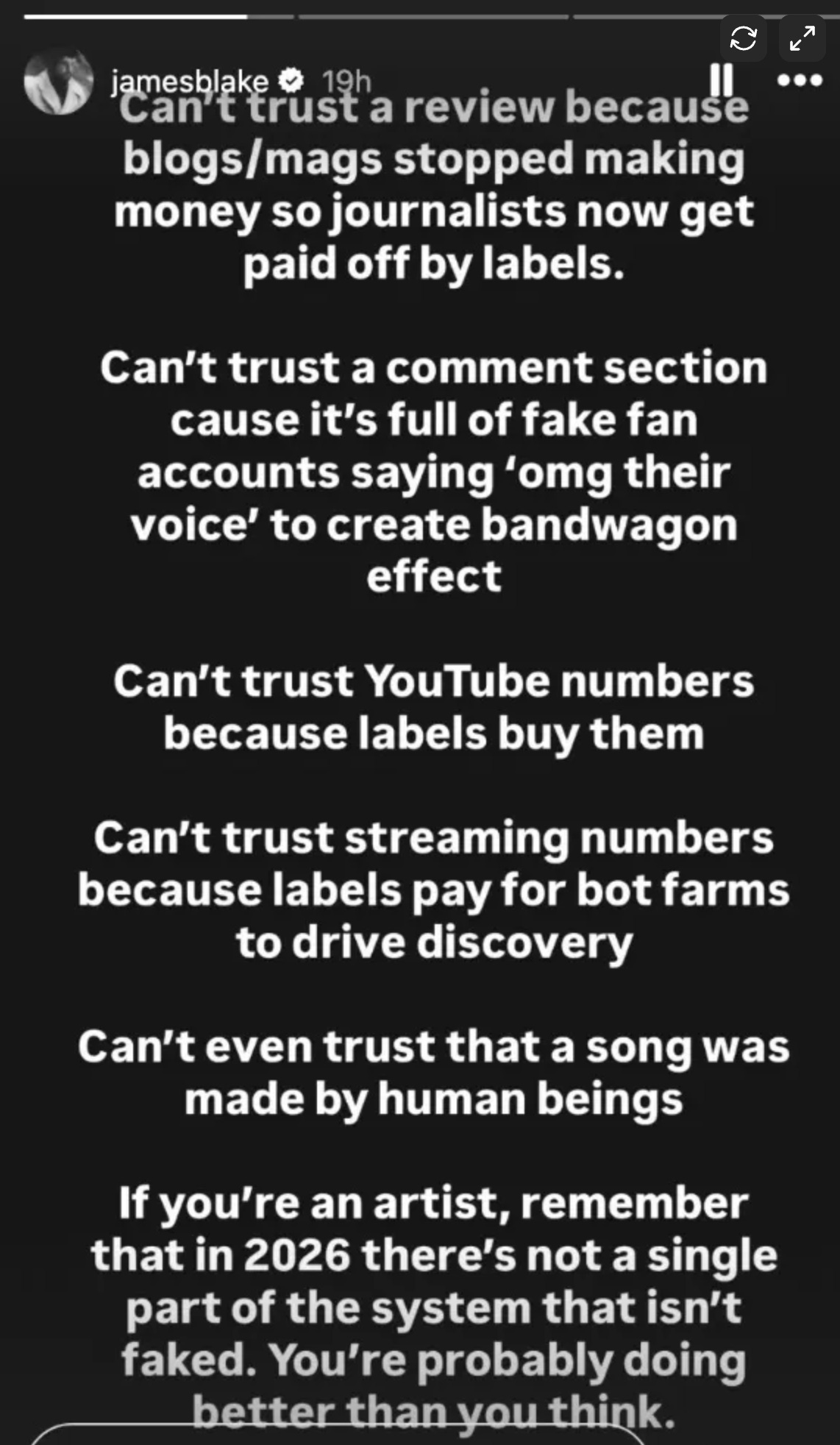
What we have here is a veritable miasma of tinfoil-hat-level paranoid bullshit.
Let’s break these down one by one.
Blake asserts that journalists now get paid off by labels. As I’m sure he’s now learning from an overwhelmed inbox of outrage responses (not to mention excellent responses like this), no journalists are being paid off by anybody. If they are, and this is a point that you’re going to be seeing repeated a lot shortly, it is an absolutely tiny number, vastly outweighed by passionate journalists writing about something they love, often for little to no money. Does that mean you can no longer trust any music review? No. That’s just absurd, sorry.
His second assertion is that all comment sections are “full of fake fan accounts”. Again, this is taking a tiny, tiny number and amplifying it to a ludicrous level to suit a narrative in which everything is fake. I’m sorry, but this is just ridiculous. Equally, I would argue it’s pretty insulting to the genuine fans who do engage, do leave comments, and enjoy spreading the word about music they love.
His third point is that YouTube views are routinely bought. Let me just state for the record that Motive Unknown currently works with about 30 indie labels and label groups and maybe 10 management companies. Through the years, I would imagine that number dials up closer to 70 or more. In almost 15 years of running this company, I have never had anybody suggest the purchase of views. Nor have I ever been aware of any client of ours actively paying for them.
All of the same points can be applied to Blake’s fourth point regarding streaming numbers. Again, I’m sure that a tiny minority of people are doing this, and there’s been proven evidence of criminal gangs using farms of mobile phones to push streams on weird releases. This does not, however, mean that any song streaming well is a direct consequence of streaming fraud. Once more, this is a paranoid hop, skip and a jump from a small problem into a completely false universal truth.
Ditto Blake’s point about songs being made by human beings versus AI. It’s easy to see that hundreds of millions of songs are churned out via Suno, Udio and other means. Yes, there are very isolated stories of one or two tracks making solid headway on DSPs. Once more, though, this does not mean that you can’t trust any song out there and that everybody should now be exceptionally paranoid about whatever they’re hearing. Are songs made using AI? Yes. Are some of those songs getting many streams on platforms? Yes. Does that mean that no song can be trusted? Don’t be ridiculous.
It is fairly easy to see that a bunch of assertions are being made here that are paranoid and factually incorrect. It is obviously problematic when somebody with the kind of audience reach that James Blake has starts talking like this. Arguably, though, another problem then stems from it, which is when music industry commentators take all of this as gospel without an ounce of critical thought and start parroting it back to their audiences.
At points I have enjoyed Joel Gouveia’s writing. Unfortunately, in the sense that I’m now referencing it in this article as an example, his piece about James Blake’s outburst is a perfect case in point of a commentator repeating bad wisdom. This is only damaging the people that may be reading this work, assuming the author is a trusted authority.
To quote:
We can no longer trust music reviews because journalists are being paid off by labels. We can’t trust comment sections because they are flooded with fake accounts trying to manufacture a bandwagon effect. We can’t trust YouTube numbers because labels simply buy them, and we can’t trust streaming numbers because bot farms are artificially driving discovery.
The irony, I feel, is that the spirit of Joel’s article is basically decent. His point is that we need to push for authenticity, and on that, I agree with him. However, there are ways to go about communicating this which don’t require repeating paranoid bad wisdom that is only making a bad situation worse.
As someone who has run a successful marketing agency for nearly 15 years, it offends me beyond belief that all marketing, and worse, all fandom, is now being dismissed as some kind of Big Fake Psyop. Articles like this one Joel posted certainly don’t help that in my view, as they perpetuate that paranoid view that we should believe nothing any more. That is absolutely and observably untrue, if like me, you are someone actually working day to day in the music industry.
Despite how it may look, I’m not attempting to single Joel out here. His article is simply an example of the kind of narrative approach I really tire of seeing at the moment. A picture is painted in which all labels are evil, or journalists are corrupt, all marketing is a psyop, all fandom is fake and literally every corner of the music industry is, on some level, institutionally corrupt. That is deeply offensive to the people actually making a living in this game, and yes, while I completely accept that there are bad actors, that notion can be applied to literally any profession on the planet and any industry you care to suggest. That’s life, basically.
It is too easy to hop on this train of thought where everything about the modern music industry is untrustworthy. I don’t buy into that perspective at all, not least because my business operates primarily in the independent sector, which is full of passionate, devoted individuals, some of whom have gone to hell and back in order to see great albums find their audiences. Don’t get me wrong: there are doubtless assholes out there too, but again, that’s life. Navigating our way through to whatever the next phase of the music industry is requires pragmatic thought, with careful consideration of the nuances involved. Simply dismissing everything going on right now as a psyop is, frankly, offensive and ridiculous. We need to be better than that and not sink to whatever headline gets the most clicks, or whichever sentiment drives the most outrage.
Have a great day,
D.
🎧 listening to “Ladybug 1” by The Bug and Dis Fig. In his latest collab with Dis Fig, armed with wonderful female vocals, The Bug’s sound appears to be evolving into something evoking a blend of Mezzanine-era Massive Attack and Rhythm & Sound. It is fantastic, dropping the usual gut-troubling low end, but all offset with that vocal that somehow brings Liz Fraser to mind. I love it.
🎧 also listening to “Found Keys” by Ruth Maine. This record has become a kind of sonic comfort blanket this last week or so. It’s a record of solo piano figures and works by an artist I was entirely unaware of before now. According to the Bandcamp page for the record, Ruth Maine has been composing for two decades but this is her first album. Quite the first step! I adore it. It’s the kind of record that actively slows your pulse, such is the comfort in its melody and resonances. Wonderful.
📖 just finished reading Kim Thayil’s autobiography, “A Screaming Life: Into the Superunknown With Soundgarden and Beyond”. As a massive Soundgarden fan, I couldn’t wait to read this autobiography, and it doesn’t disappoint. What separates Kim Thayil from most is a studied pragmatism, and his depiction of what life as a rock star is really like is quite likely to ensure none of you would ever want to be one. It isn’t the tropes of drug abuse etc, though certainly that orbits around the author. It is more the chronic isolation that one can feel, that ultimately separates you even from your bandmates, tearing a band apart in the process. A brilliant read.
📖 now re-reading Harry Sword’s incredible “Monolithic Undertow”. I cannot say enough great things about this work, which starts by looking at the nature of drone music and that heaviness that connects deeply to religion and spiritual exploration, before moving on to examining how that manifests in anything from the music of John Cale through to the work of Sunn 0))). Honestly, just read it and thank me later: it is a masterpiece.
Gleefully accepting music recommendations!
I do really enjoy getting suggestions for either existing music or forthcoming releases to check out. So, if there’s something you think I might like, do feel free to get in touch. Always keen to hear the weird and wonderful things going on out there. And, with 6000+ subscribers, I’m happy to spread word on things I’m loving too.
Darren, you bring up some good points here, but I wouldn't go as far as calling Blake's comments "tinfoil-hat-level paranoid bullshit."
A lot of music journalism is authentic and nobody is cutting checks for verdicts, on that we agree. But the big press placements, the magazine interviews, the publication album reviews?? Much of that requires a press team on retainer with a pretty large price tag attached. The writer may be incorruptible, but most of the time the pitch never reaches them without paid representation, and that access layer is invisible to the reader. So sure, no one is saying "hey, review my album, here's $500" to a thousand journalists - but paid access still decides what gets covered.
On fake fan accounts, I think this article downplays how blurry that line has become. Clipping campaigns are now the most cost-efficient form of social media marketing going, well beyond music.. real people, posting real clips, for pay. the viewer scrolling past has no way to distinguish organic enthusiasm from paid amplification, and that's the distrust Blake was actually pointing at, even if he named it clumsily.
On YouTube we mostly agree. I've run campaigns for artists, podcasts, and long-form video, and money put behind a video translates directly into views- no bot farm required, because the platform sells reach at a literal price per view. You know that metric as well as I do. So "buying views" is less conspiracy than product feature- the disagreement is about the word, not the mechanics.
Where I'd push back hardest is your summary of my article saying that all labels are evil, all journalists are corrupt, every corner is institutionally rotten. That exaggerates the point, which was narrower: a vast majority of the metrics the industry stares at are illusions. Monthly listeners, follower counts, press placements - none of them carry the weight they used to, and pretending otherwise serves nobody.
And for the record, I can't stand the term psyop either. Geese became popular because they make amazing music. How it got in front of millions of eyes doesn't change the fact that they're just a great band.
I'm not sure if the "industry commentator with no skin in the game" comment was directed at me but that one isn't true. I've spent a decade in this industry managing artists, working in the PRO system, music supervising projects, running music festivals, and booking tours and shows. I'd hope it wasn't, but as the only commentator named in the piece, you can see why I'd wonder.
I appreciate the commentary regardless.. thanks for the shout out.
The rise of the Grifter Industrial Complex in most areas of our lives coupled with the erosion of trust in just about everything have led us here. With music specifically, we've always been pretty good at turning on artists who fast-track the path from obscurity to mainstream success. "Psy-Op" is just the 2026 equivalent of "Sellout" in the 90s.
P.S. If every music writer is on the take, well, I guess I'd like to know when I can expect my checks to start rolling in...